Other Projects
Beyond CoachKai.
CoachKai is one thread. Alongside it, I've been building, researching, and thinking across AI systems, enterprise workflows, product strategy, and digital ventures. This is a view into that broader body of work — some shipped, some in progress, some exploratory.
Featured Projects
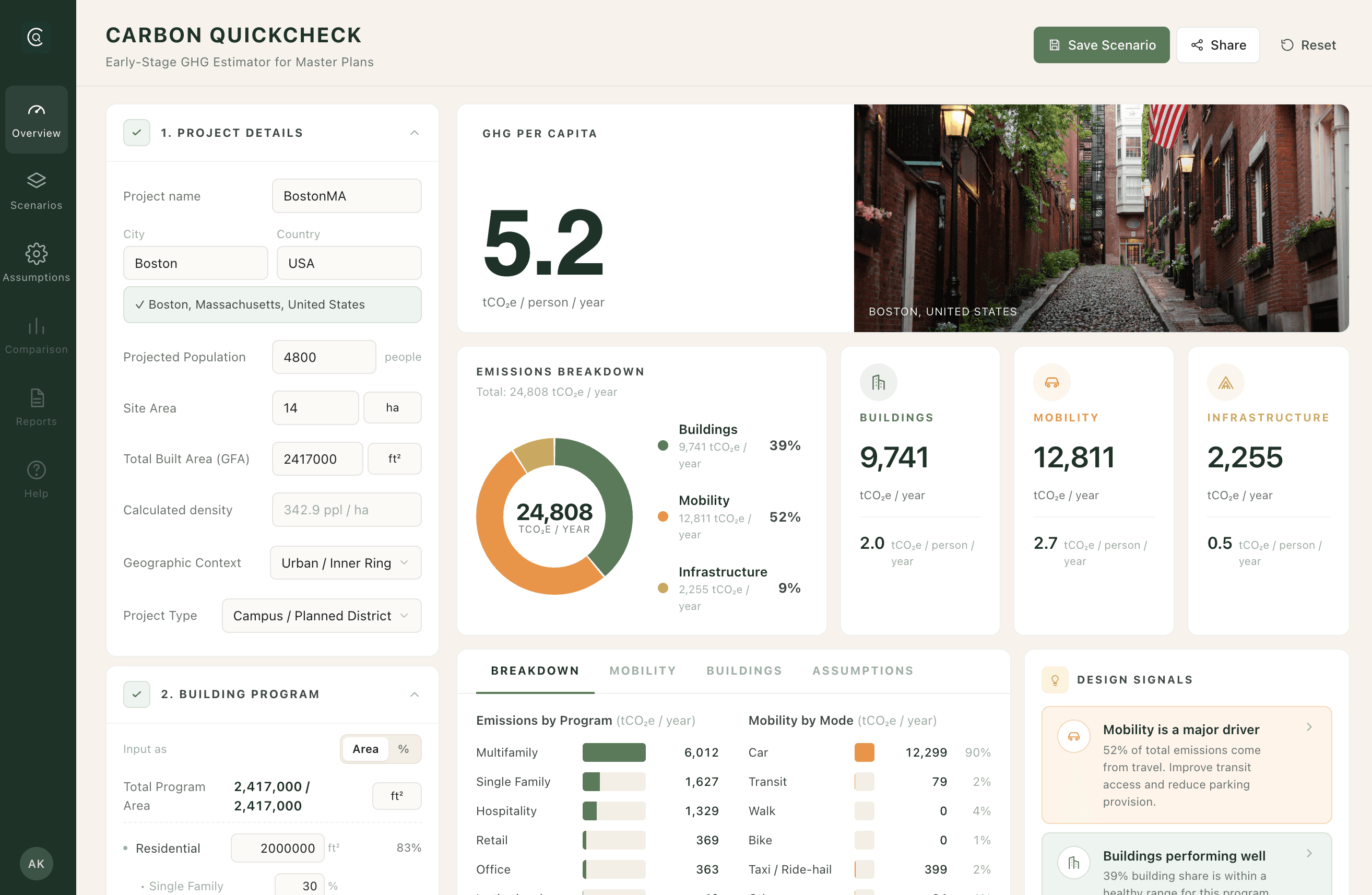
Carbon Quick Check
Early-stage operational carbon estimator for urban master plans.
Master-planning is where carbon decisions are cheapest to change but the data is sparsest. Carbon Quick Check turns sparse project inputs — location, population, site area, GFA, building program, mobility, grid mix — into GHG-per-capita estimates and scenario comparisons for urban planners and architects. I designed it, worked out the underlying carbon model, and shipped it end-to-end solo with AI-assisted development.
- Built an operational-carbon estimation model for the master-planning stage, where design changes are cheapest.
- Turned sparse inputs — population, site area, GFA, program, mobility, grid mix — into per-capita GHG estimates.
- Designed, scoped, and shipped end-to-end as a solo build with AI-assisted development throughout.
- Focused the UX on a defensible early number and scenario comparison, not a false-precision dashboard.
Im.Ally
AI-assisted immigration guidance and compliance platform.
Immigration processes are opaque, anxiety-inducing, and poorly served by existing digital tools. Im.Ally is an AI-assisted platform designed to make that experience navigable — combining contextual guidance, compliance support, and user-facing product design built around trust, not just information delivery.
- AI-guided navigation through complex immigration pathways and eligibility requirements
- Compliance support with contextual explanation — not just rule citations
- Product design focused on clarity and calm during high-stakes, time-sensitive decisions
- Exploratory integration of document analysis, status tracking, and personalised guidance flows
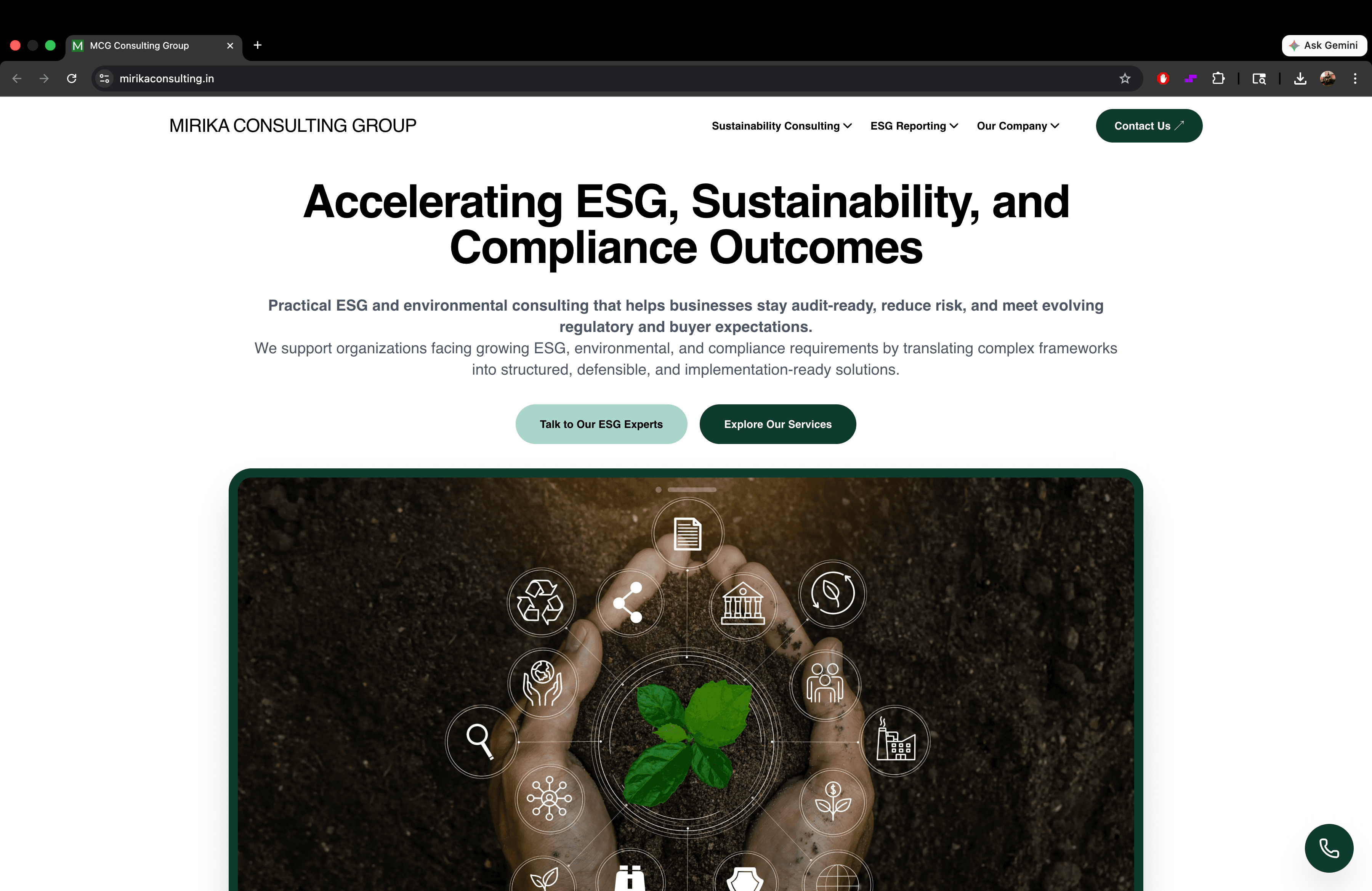
Mirika Consulting Group
Brand, digital presence, and product strategy for a sustainability consulting firm.
A complete product strategy, positioning plan, website design, development roadmapping effort for Mirika Consulting Group — a sustainability and ESG-focused advisory practice. The challenge was translating a nuanced, high-trust consulting proposition into a clear, compelling productized service case that worked for both enterprise clients and founders.
- Built a multi-phase product roadmap covering launch, growth, and future platform expansion.
- Created the website strategy, structure, and messaging for a sustainability and ESG audience.
- Helped shape how consulting services could evolve into a carbon accounting platform.
- Used product thinking to make the offering clearer, more credible, and easier for clients to understand.
Explorations & Research
Active threads.
Ongoing explorations across AI systems, enterprise workflow, and product strategy — some documented, some actively being built, all actively shaping how I think.
Agentic Sales Workflow
AI agents as intelligent infrastructure for sales and revenue operations.
An exploration into how agentic AI architectures can reshape sales and revenue operations — moving beyond simple task automation toward agents that reason, prioritise, and follow through on complex multi-step activities across CRM, outreach, and pipeline management.
- Agentic CRM enrichment and intelligent follow-up orchestration
- Pipeline reasoning and priority scoring across incomplete data
- Multi-step workflow automation for sales motion execution
AI Agent Observability
Telemetry, traceability, and reliability patterns for production AI agents.
How do you know if your AI agent is working — and how do you know when it isn't? An exploration of the instrumentation, logging, and evaluation patterns needed to run agentic systems reliably: tracing decisions, detecting failure modes, and measuring performance across complex multi-step workflows.
- Decision tracing and explainability for multi-step agent behaviour
- Failure detection patterns and graceful degradation strategies
- Latency, reliability, and performance benchmarking for production agents
Token Economics
Strategic analysis of usage-based pricing and cost models for AI products.
A structured analysis of how token economics shape AI product design, cost transparency, and monetisation strategy. Examining the tension between capability, usage, and cost — and what those dynamics mean for how AI products are built, scoped, priced, and positioned for different markets.
- Usage-based pricing architectures and cost-to-serve modelling
- Token transparency and cost communication as a product trust lever
- Implications for product scoping, feature gating, and AI monetisation strategy
Enterprise AI Copilot Design
Design principles and deployment patterns for AI copilots in enterprise settings.
Informed by hands-on work building and deploying AI copilots with Microsoft Copilot Studio at scale, this is an ongoing exploration of what determines whether enterprise AI copilots actually get adopted — covering persona design, failure modes, change management, and the gap between capability and real-world usefulness.
- Persona and constraint design for reliable, role-specific copilot behaviour
- Adoption patterns and the gap between AI capability and user trust
- Integration architecture for enterprise knowledge, identity, and workflow systems
Local LLM Evaluation
A scripted framework for benchmarking open-weight models on real hardware.
Built during the CoachKai development cycle, this is a set of Python and PowerShell scripts for systematic local model evaluation — comparing reasoning quality, instruction-following consistency, latency, and domain performance across open-weight models under real hardware constraints.
- Automated query and response benchmarking across multiple models
- Domain-specific evaluation criteria for coaching and advisory use cases
- Hardware-constraint-aware testing across quantisation levels and context lengths
RAG Architecture Patterns
A documented study of knowledge retrieval design decisions for AI systems.
A structured exploration of retrieval-augmented generation design decisions — chunking strategies, embedding model selection, retrieval precision vs. recall tradeoffs, and knowledge formatting patterns. Developed from direct experimentation across CoachKai, enterprise knowledge systems, and exploratory AI builds.
- Chunk size, overlap, and boundary strategy for different knowledge types
- Embedding model evaluation for domain-specific retrieval precision
- Knowledge formatting and schema design as a first-class engineering concern
What's next
More in progress.
These projects reflect how I think — across multiple fronts simultaneously, with a bias toward building over theorising. If any of these areas overlap with what you're working on, I'd like to hear about it.